
Translating rhythm is translating too
When we talk about literary translation, we usually think about meaning, fidelity, tone. But there’s something more subtle — and vital — that often gets left out: the musicality of the original text.
That cadence that makes the reading flow, that lets the reader breathe with the text.
That gets translated too. Or it should.
What do we mean by “musicality” in a text?
- 🔁 The internal rhythm of sentences
- 🧘♀️ The alternation between pauses and flow
- 🎵 The sound balance between syllables, words, and silences
- 🧠 How easily the reader “enters” and lets themselves be carried along
A text with musicality doesn’t need to be poetic. But it has to sound right to the reader’s inner ear.
Why does it get lost in translation?
Because every language has its own natural rhythm. What flows in English with short, direct sentences can sound abrupt in Spanish. And what builds tension in German through long structures can come across as confusing or artificial in Spanish.
The challenge is carrying the rhythm over… without breaking the target language.
Keys to preserving musicality when translating into Spanish
✍️ 1. Read it out loud
The most basic and the most effective. The mouth and ear catch what the eye misses: abrupt cuts, awkward sound clashes, sentences that fall flat.
🔁 2. Listen to the tempo of the original
Every author has a pulse. And every scene has a rhythm. In narrative texts, it’s just as important as the plot.
🎯 3. Choose words that sound like what they mean
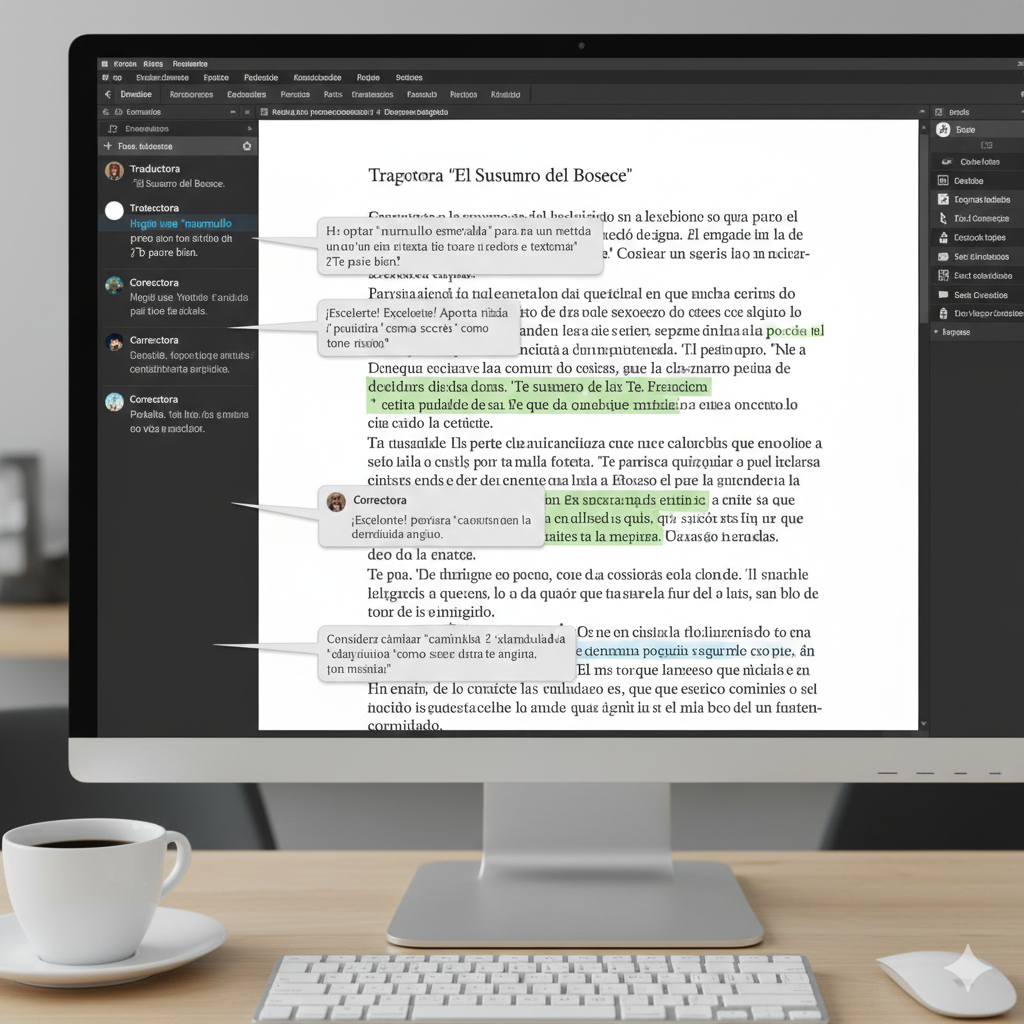
In Spanish, we have rich options with real sonic weight. “Crujir” doesn’t sound like “hacer ruido.” “Susurro” doesn’t land the same as “voz baja.”
⏸️ 4. Use punctuation as a rhythmic tool
Commas, periods, dashes… everything that gives the text room to breathe shapes how it feels.
🔄 5. Accept intentional rewriting
Sometimes translating means reorganizing. Splitting one sentence into two. Changing the order. Cutting a repeated word even if it’s in the original. Not out of disloyalty, but out of care.
What if I don’t want to lose the author’s voice?
That’s the heart of it all: preserving the intention without copying the form.
When a work is well translated and reviewed with musicality in mind, the reader doesn’t think “this came from English/German.” They just get carried along.
As a copyeditor, that’s my goal: keeping the music even as we change languages. That it sounds right. That it’s read with pleasure. That the translation doesn’t show.
Do you have a translation that needs its rhythm fine-tuned?
I offer a free one-page review to spot whether the text preserves its musicality or whether there are adjustments that could improve it without breaking its tone.