Translated doesn’t always mean connected
Maybe you invested time and budget in translating your funnel or your onboarding. The content is there in the target language, but the results… aren’t coming. Low open rates, few clicks, little connection.
That’s because translating an email sequence isn’t just about changing the language. It’s about adapting the reading experience so it sounds natural, builds trust, and drives action.
What’s blocking conversion in translated emails?
❌ Tone that doesn’t resonate
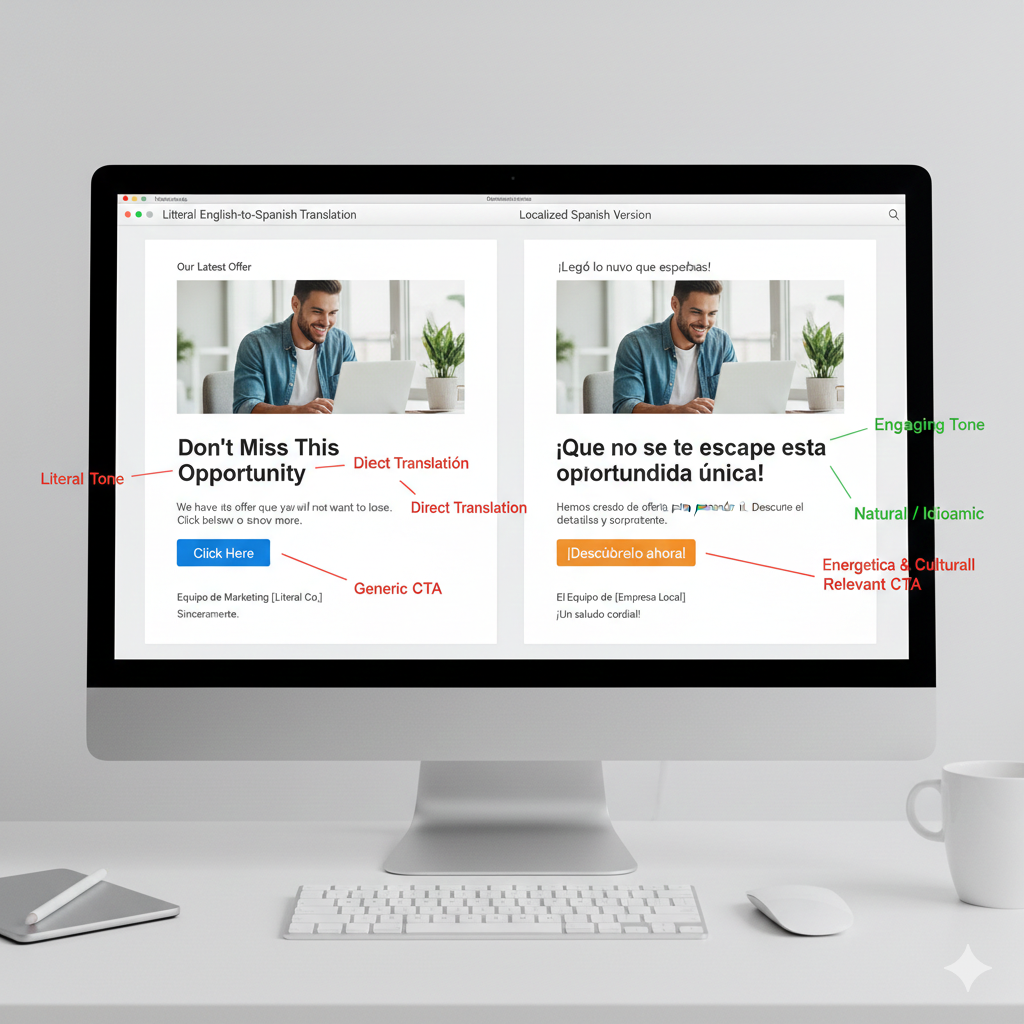
The style that works in the source language (direct, enthusiastic, even imperative) can come across as forced or invasive once translated.
❌ CTAs that don’t invite action
Phrases like “Grab your free trial now” translated word-for-word can sound generic or unnatural.
❌ Literal phrases or calques
Poorly translated idioms, out-of-place cultural references, or turns of phrase that just sound odd.
❌ Lack of fluency
Emails that read like translations. And that creates distance.
What localization does (and why it matters so much)
Localization isn’t just translation. It brings:
- 📌 Tone adapted to the market
- 📍 Structural changes to improve clarity and rhythm
- 💡 Rewording of key phrases without losing intent
- 🤝 A review of everything that shapes the experience: subject lines, greetings, sign-offs, buttons, PS…
Localizing means creating a sequence that works in the target language as if it had been written from scratch for that audience.
How I approach it in my projects
I work with SaaS, wellness, and digital education brands that need their voice to come through clearly and naturally in Spanish.
My process includes:
- A full read-through of the sequence
- Tone adjustment for the target audience
- Reworking CTAs, subject lines, and sensitive passages
- Consistency in voice and narrative structure
- And, if needed, coordination with the design or automation team
Because every email is a micro-encounter. And every word, a chance to connect.
How do you know if you need to localize your sequence?
Take this quick test:
- Are your open or click rates very low?
- Have people told you the emails “don’t sound right” or “are hard to follow”?
- Do you notice the original intent gets lost in translation?
- Are you relying on machine translation with no review?
- Are you unsure whether your tone sounds professional or just too neutral?
If you answered “yes” to two or more, localization could transform that sequence.
Want to review an email sequence that isn’t performing as expected?
I offer a free review of one key email to see if localization could be the solution.