
Translation isn’t the finish line
Your product can be fully translated and still feel foreign.
That’s one of the biggest reasons localisation projects underperform.
Because users don’t experience translated strings.
They experience products.
Every click.
Every decision.
Every moment of uncertainty.
Every onboarding screen.
Every confirmation message.
Even when translations are accurate, small linguistic decisions can introduce friction into the user experience.
Friction during onboarding.
Friction during activation.
Friction during feature discovery.
Friction during retention.
Users may never realise why something feels slightly off.
They simply hesitate.
Or leave.
That’s why localisation isn’t just about language.
It’s about creating an experience that feels natural from the very first interaction.
What UX localization actually means
UX localization goes far beyond translating interface copy.
It focuses on how language supports users throughout the entire product journey.
That includes:
- Navigation labels
- Calls to action
- Empty states
- Error messages
- Onboarding flows
- Product emails
- Notifications
- Tooltips
- Confirmation screens
- Help content
The real question isn’t:
Is this translated correctly?
It’s:
Does this feel like it was designed for users in this market?
Those are two very different questions.
UX localization is part of product design
Many SaaS teams still treat localisation as one of the final steps before launch.
The interface is translated.
QA is completed.
The product ships.
But language isn’t a finishing touch.
Language is part of the product itself.
Every CTA influences behaviour.
Every message builds trust—or weakens it.
Every interaction either removes friction or creates it.
When users interact with your product, they don’t separate UX from language.
Neither should your team.
The most successful global SaaS companies don’t just localise words.
They localise decisions.
A common SaaS scenario
Imagine a product originally built in English.
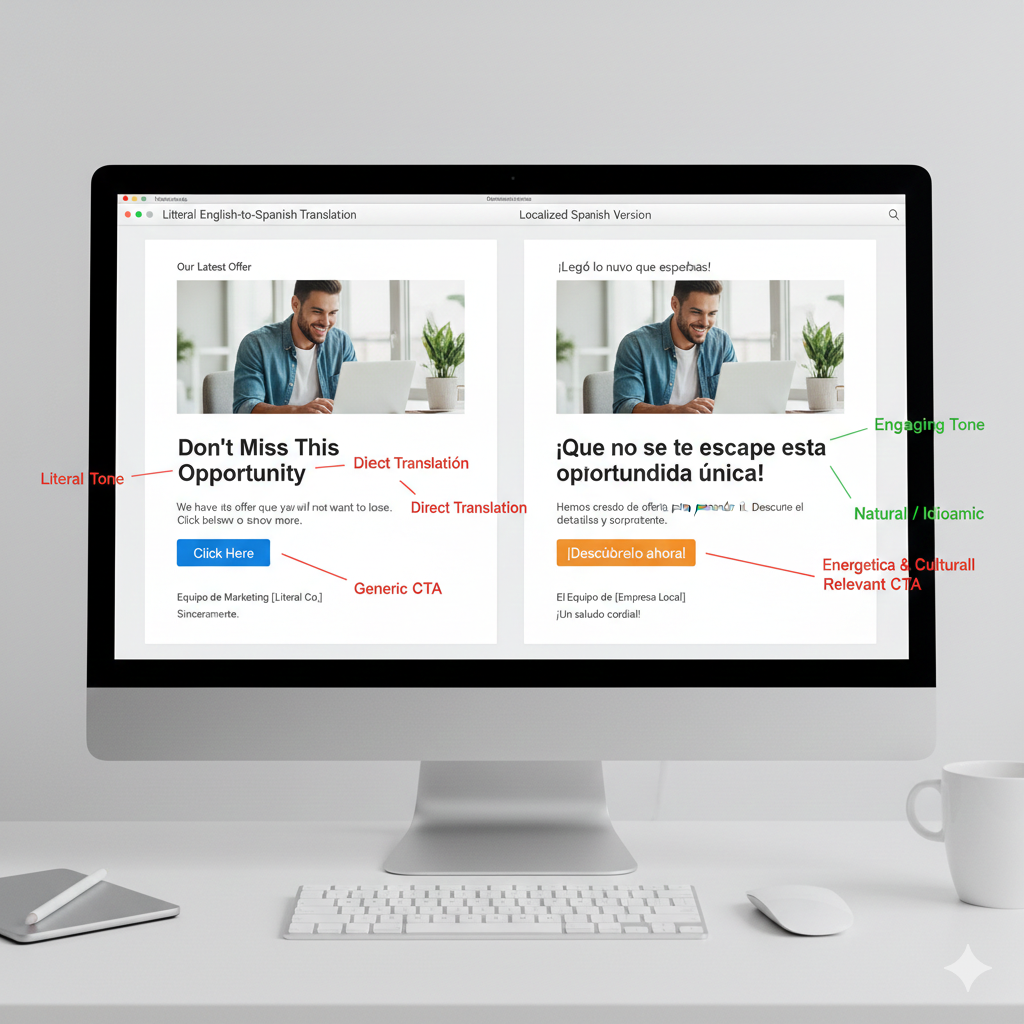
The onboarding flow includes the CTA:
Get Started
The Spanish version becomes:
Comenzar
It’s perfectly correct.
Yet activation rates in Spain remain lower than expected.
The issue isn’t linguistic accuracy.
It’s user experience.
Perhaps the CTA doesn’t communicate enough value.
Perhaps the surrounding copy feels too generic.
Perhaps users need more reassurance before committing.
Perhaps competitors use language that feels more familiar and trustworthy.
Nothing is technically wrong.
Yet nothing truly connects.
When the translation is correct, but the product still feels foreign
One of the biggest misconceptions in localisation is believing that accurate translation automatically creates trust.
It doesn’t.
Users don’t evaluate translations.
They evaluate experiences.
Think about checking into a beautifully designed hotel.
Everything looks perfect.
But the signs feel unfamiliar.
The instructions don’t match local expectations.
The light switches are in unexpected places.
Nothing is broken.
Yet nothing feels effortless.
Many localised digital products create exactly the same experience.
Is your Spanish UX helping users move forward?
Your product may already be translated.
That doesn’t necessarily mean it feels local.
If users hesitate during onboarding, struggle to understand key interactions, or simply don’t engage as expected, the issue may not be your product.
It may be the language experience.
A UX Language Review helps uncover hidden friction across onboarding, interface copy, product messaging and user journeys, so your Spanish product feels as intuitive, trustworthy and effective as the original.