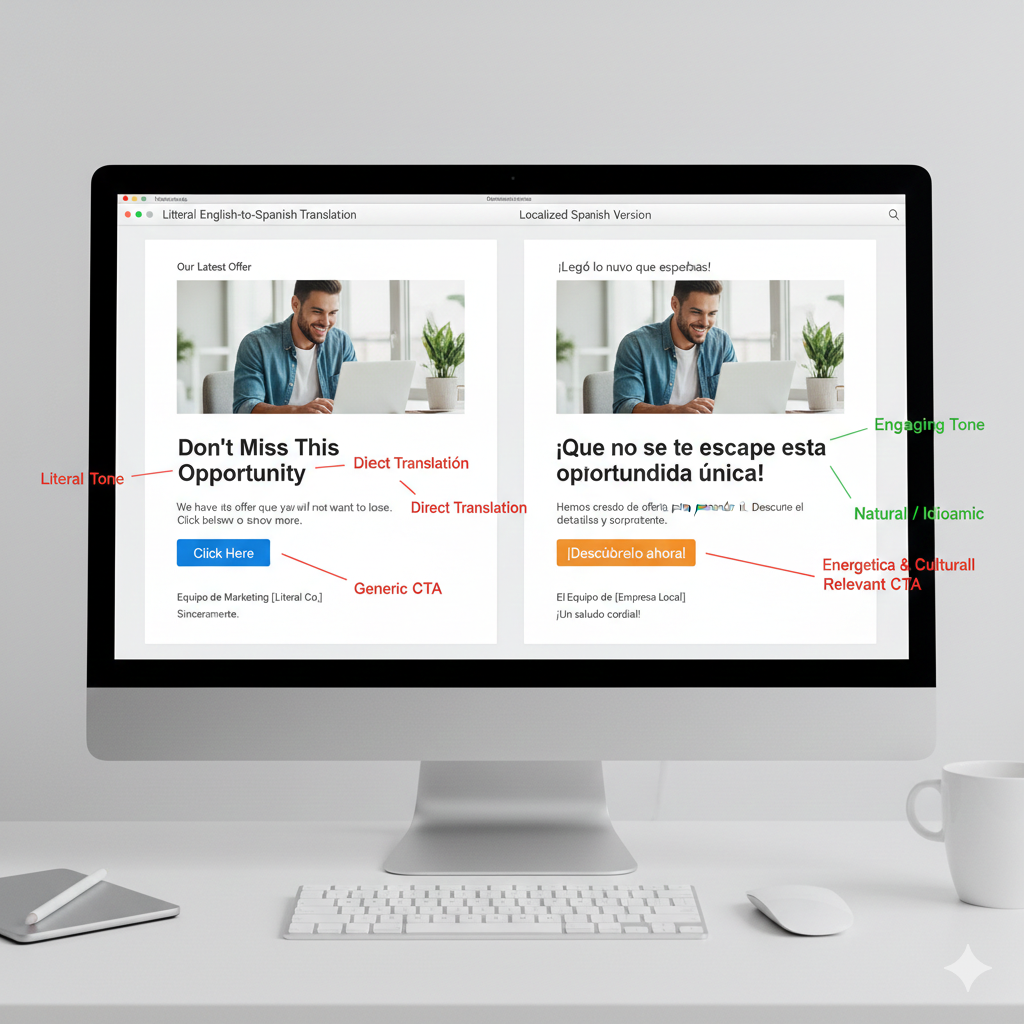
Two Processes That Are Often Confused
Ask a localization team whether they’ve reviewed their translations and the answer is usually yes.
Ask whether they’ve performed Localization QA and the answer becomes less certain.
The confusion is understandable.
Both processes involve language. Both aim to improve quality. Both happen during localization workflows.
Yet they solve entirely different problems.
And confusing one for the other can leave significant issues hidden inside a product experience.
The difference is straightforward:
Translation Review checks whether language is correct.
Localization QA checks whether the localized experience works.
Both matter. But they are not interchangeable.
Why This Difference Matters More Than Ever
As products expand globally, localization becomes increasingly complex.
A modern SaaS product may contain:
- Website content
- Product interfaces
- Onboarding flows
- Notifications
- Email sequences
- Knowledge bases
- Mobile applications
Thousands of strings move through translation workflows.
But users never experience strings.
They experience products.
And that’s where the distinction becomes important.
A translation can be perfect inside a spreadsheet and still create a poor experience inside the product itself.
What Is Translation Review?
Translation Review focuses on linguistic accuracy.
The reviewer evaluates whether the translated content:
- Preserves the original meaning
- Uses correct terminology
- Follows style guidelines
- Maintains consistency
- Avoids grammatical errors
Translation Review typically happens before implementation.
The reviewer often works with:
- Translation management systems
- CAT tools
- Bilingual files
- String lists
The central question is:
“Is this translation correct?”
A Simple Example
Source:
Start your free trial
Spanish translation:
Empieza tu prueba gratuita
The reviewer confirms that:
- The meaning is preserved
- The grammar is correct
- The terminology is appropriate
From a linguistic perspective, the review is complete.
What Is Localization QA?
Localization QA happens inside the actual product.
The goal is not only to evaluate language. It is to evaluate the entire localized experience.
This includes:
- Context
- Layout
- Functionality
- UX copy
- Brand voice
- Cultural appropriateness
The central question becomes:
“Does this work for the user?”
The translation may be perfectly accurate.
But Localization QA may reveal:
- Text truncation
- Broken placeholders
- Inconsistent terminology
- Confusing navigation
- Awkward CTAs
- Brand voice issues
- UX friction
These are problems that may be impossible to detect from translation files alone.
A Real-World Example
Imagine a product button translated as:
Empieza tu prueba gratuita
The Translation Review approves it. Everything looks correct.
During Localization QA, however, the reviewer notices that:
- The button is too small
- The text wraps awkwardly
- Nearby messaging uses a different tone
- The CTA feels less persuasive than competing products in the Spanish market
Nothing is technically wrong.
Yet the user experience suffers.
This is exactly why Localization QA exists.
Translation Review Focuses on Language
Translation Review asks questions such as:
Is the meaning accurate?
Has anything been mistranslated?
Is the terminology consistent?
Are key product terms used correctly?
Is the grammar correct?
Does the translation follow language standards?
Does it match style guides?
Is the content aligned with linguistic guidelines?
These questions are essential.
But they only represent one layer of quality.
Localization QA Focuses on Experience
Localization QA asks different questions.
Does the text fit the interface?
No truncation. No layout issues. No visual friction.
Does the content make sense in context?
Buttons, menus, error messages, and user flows all need to work together.
Does the tone support the product experience?
This is especially important for:
- SaaS
- HealthTech
- Financial products
Does the product feel local?
Not simply translated.
Local.
The Most Common Problems Localization QA Reveals
1. Text Expansion Issues
Spanish, German, and French often require more space than English.
Interfaces break. Buttons overflow. Menus become unreadable.
2. Contextual Errors
A translation that looks correct in isolation may be incorrect on the actual screen.
Without context, reviewers cannot always identify these issues.
3. Inconsistent Brand Voice
Marketing sounds human.
The product sounds robotic.
Emails sound formal.
Support sounds different again.
Localization QA helps identify these disconnects and create a more consistent experience across touchpoints.
4. Functional Issues
Broken variables, incorrect placeholders, formatting errors, and inconsistencies in dates and numbers can affect usability directly.
5. UX Friction
The language may technically work.
But does it guide users effectively?
That’s a UX question.
And often a localization question too.
Why Translation Review Alone Is Not Enough
Translation Review evaluates the linguistic quality of individual pieces of content.
Localization QA evaluates how those pieces work together inside a real experience.
One process evaluates content.
The other also evaluates the context in which that content appears.
Companies that skip Localization QA often discover problems only after launch.
At that point, fixing them can require more time, more coordination, and additional rounds of work.
And users have already encountered the friction.
Where Localization QA Creates Business Value
Localization QA is often viewed as a quality assurance step.
In reality, it supports broader business goals.
Better Onboarding Experiences
Users understand what to do next.
Stronger Brand Consistency
Every touchpoint sounds like the same company.
Lower Support Costs
Users encounter fewer confusing moments.
Improved Trust
This is particularly important in regulated or sensitive industries.
More Confident Market Launches
Teams can verify that the product feels local before users encounter it.
How I Approach Localization QA
When reviewing a localized product, I focus on the experience as a whole.
I look beyond strings and terminology.
I evaluate:
User Journeys
Where does friction appear?
UX Language
Does the copy support decisions?
Brand Voice Consistency
Does the product sound like itself?
Product Context
Does every message make sense where it appears?
Linguistic Experience
How does the product feel to a real user?
Because users don’t judge localization one string at a time.
They judge it one experience at a time.
Language Is Part of the Product
Translation Review ensures language is correct.
Localization QA ensures language works.
Both are essential.
But if your goal is to create products that feel intuitive, trustworthy, and local, correctness is only the starting point.
The ultimate question is not:
“Was this translated accurately?”
It’s:
“Does this experience feel natural to the people using it?”
That’s the difference between translation quality and localization quality.
And it’s where Localization QA makes all the difference.
FAQ About Localization QA
What is the difference between Translation Review and Localization QA?
Translation Review focuses on linguistic accuracy. Localization QA evaluates how localized content performs inside the actual product experience.
Is Translation Review part of Localization QA?
Not exactly. They are complementary processes. Translation Review typically happens before implementation, while Localization QA happens within the product environment.
Do SaaS products need Localization QA?
Yes. SaaS products contain complex user journeys, interfaces, and interactions that cannot be fully evaluated through Translation Review alone.
When should Localization QA happen?
Ideally before launch, major releases, or expansion into new markets.
It can also be useful when a localized product is already live but teams are seeing recurring issues with consistency, tone, context, or user experience.