Imagine being able to peek through a little hole and see how technical translators work. I’m convinced plenty of it would catch your attention.
You might be wondering: “With so many fascinating fields out there, why technical translation? How can you actually enjoy translating documents about how an engine works?”
And yes, it’s easy to picture the appeal of other specialties:
– translating subtitles for a show with international reach
– the prestige of conference interpreters working at international organizations
– literary translation in your favorite genre (comics, historical fiction, poetry…)
– court interpreting on highly topical cases
You might also be thinking: “But weren’t you more of a humanities person…? How did you end up translating industrial process documentation?”
Discover more about how technical translators work with these four curious facts
To clear up all these mysteries, here are a few curious facts about the work of technical translators.
1. A love of learning and discovery defines us technical translators. Engineering and technology translation appeals to us especially because we’re very curious people. We love investigating cause-and-effect relationships and how machines work. This specialty feeds our need to keep learning, nonstop.
Let’s look at some examples. If we want to faithfully carry over what a set of technical spec sheets for an industrial plant say, we first need to understand the components, their purpose, and their context. It’s essential to understand how the parts work, what the components look like, what they’re for, and where they sit in the production chain…
In many cases, drawings or diagrams accompanying the documentation, detailed operating descriptions, or engineers’ notes are incredibly useful for cracking these puzzles.
Terminology glossaries that many clients build and update over the years are also a huge help. Those lists mapping terms from one language to another ensure the client-approved term is always used in the translation. That keeps consistency across different translators and different products from the same company.
2. It involves a lot of research work. From the moment you receive the text in English or German, as is my case, until you produce the translated text, we go through a long research process. In this process, we break the text apart, dig into the details, look for similar texts (which we call parallel texts) originally written in our own language, and consult subject-matter experts about anything we’re unsure of…
I recently got in touch with a distillation expert to make sure I had the right Spanish name for a part of a three-plate bell. For one German part (Röhrenkühler), I found three different possible meanings in Spanish, and only that way could I make sure I picked the right one for this context: “serpentín” (coil). I then checked with the client, who confirmed it.
The internet gives technical translators endless sources to draw on. For that same translation, everything pointed to “deflegmador” being a calque from English, and that surely there was a better term in Spanish. In the end, the Real Academia de Ingeniería dictionary settled it for me, since it includes the entry for “deflegmador” and “deflegmación”: partial condensation of a mixed vapor in order to collect the condensate rich in higher-boiling-point components.
Other times, searching the internet for photos and wikis explaining that component or part in German is a big help, and once I have a crystal-clear picture of what it is, I search for Spanish equivalents until I find the term actually used in the industry. For example, I looked up cable car cabin types on German Wikipedia, and from there found the exact equivalent term in Spanish.
This research phase is definitely my favorite. It helps us compare and decide on the best way to translate expressions, concepts, and structures depending on context.
3. Varied specialization. Variety is the spice of life, as they say. It’s very common for a single translation to touch on several fields of expertise at once. For example, when we’re asked to translate a website for a renewable energy company, technical translators run into a huge range of text types: from pure, hardcore technical documentation laid out in tables to product descriptions with a touch of persuasive copywriting, not to mention legal notices tied to applicable EU regulations. Something similar happens when we translate patents, where technical and legal translation meet. I especially love it when technical and marketing content overlap — which happens a lot in brochures and product pages for electro-medical equipment, for example.
4. High demand, little quality supply. Technical texts are often cumbersome and poorly written — and here I mean both the originals and the translations. Sometimes it’s a real challenge to carry the ideas and nuances of the original over into the translated text. In many cases, you have to rewrite it from scratch. This lack of well-written texts might explain why there’s still such high, unmet demand for technical translators. That’s an opportunity for translators who take real care with writing and style.
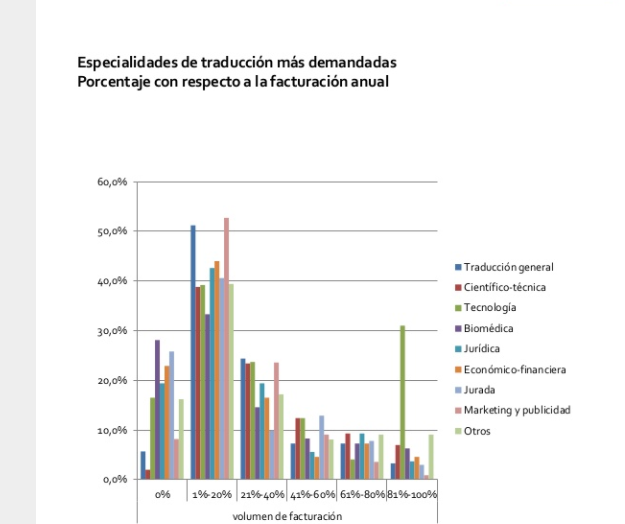
Report on the translation industry in Spain (2014-2015) by Celia Rico Pérez and Álvaro García Aragón. And that wraps up these curious facts about the work of technical translators. I hope they brought you a little closer to our day-to-day, and that you enjoyed them.
And that wraps up these curious facts about the work of technical translators. I hope they brought you a little closer to our day-to-day, and that you enjoyed them.